 HSL Mobile App
 Closing Auction Session CAS A Step by Step Guide
-202607301444507262959.png)
Starting August 03, 2026, SEBI is introducing a Closing Auction Session (CAS) for equity shares on which Futures & Options (F&O) contracts are available.
This changes how the closing price is determined and how trading works after 3:15 PM for these eligible shares.
Whether you are a delivery investor, intraday trader or F&O trader, this guide explains what changes, how the new process works, and what it means for your trades.
What is the Closing Auction Session?
Every trading day, a stock has a closing price. This price is important because it is used for activities such as derivatives settlement, index calculation, ETF rebalancing etc.
Until now, the closing price of eligible shares has been calculated using the Volume Weighted Average Price (VWAP) of trades executed during the last 30 minutes of regular trading.
Starting August 03, 2026, this will change for equity shares on which Futures & Options (F&O) contracts are available.
Instead of calculating the closing price from trades executed during the last 30 minutes, the exchange will conduct a Closing Auction Session (CAS) after regular trading ends. During this auction, eligible buy and sell orders are collected and matched to determine a single closing price.
Understanding Key Indicators in the Closing Auction Session (CAS)
To better interpret the Closing Auction Session (CAS), it's important to understand a few key indicators displayed during the auction.
1. Reference Price
The Reference Price is the Volume Weighted Average Price (VWAP) of all trades executed between 3:00 PM and 3:15 PM. This serves as the reference around which the closing auction is conducted.
2. Indicative Equilibrium Price (IEP)
The Indicative Equilibrium Price (IEP) is the price at which the maximum quantity of buy and sell orders can be matched at that moment. In simple terms, it is the likely closing price if the auction were to end immediately.
As new buy and sell orders enter the auction, the IEP keeps changing in real time. Once the auction ends, the final IEP becomes the official closing price.
3. Indicative Imbalance Quantity (IIQ)
The Indicative Imbalance Quantity (IIQ) indicates whether there are more buyers or more sellers at the current IEP.
- 🟢 Positive IIQ: More buyers than sellers, indicating stronger buying interest. If this trend continues, the closing price may move higher.
- 🔴 Negative IIQ: More sellers than buyers, indicating higher selling pressure. The closing price may move lower.
- ⚪ IIQ = 0: Buyers and sellers are perfectly balanced, suggesting equilibrium at the current price.
Example
Suppose a stock is trading around ₹100, and the following orders are available during the closing auction:
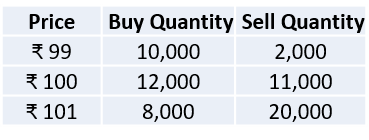
At ₹100, the highest tradable quantity of 11,000 shares can be matched.
Therefore:
- Indicative Equilibrium Price (IEP): ₹100
- Tradable Quantity: 11,000 shares
Why Should Investors Care?
These indicators provide valuable insights before the market officially closes:
- Understand the likely closing price before the auction ends.
- Gauge whether buyers or sellers are dominating the market.
- Modify or cancel orders based on evolving auction dynamics.
- Avoid surprises in the final closing price.
Benefits for Traders
For active traders, especially intraday, arbitrage and algorithmic traders, these indicators offer several advantages:
- Real-time visibility into buying and selling pressure.
- Better decision-making during the closing auction.
- Improved execution near the market close.
- Greater transparency and confidence in the price discovery process.
Ultimately, the Reference Price, IEP and IIQ improve transparency, reduce the possibility of market manipulation, and help ensure that the official closing price accurately reflects genuine market demand and supply.
Related Posts
Don't miss another Article
Subscribe to our blog for free and get regular updates right into your inbox.
Categories




Subscribe for our
newsletter
newsletter
