 HSL Mobile App
 End of easy money:A look at the consequences
HDFC, Tester
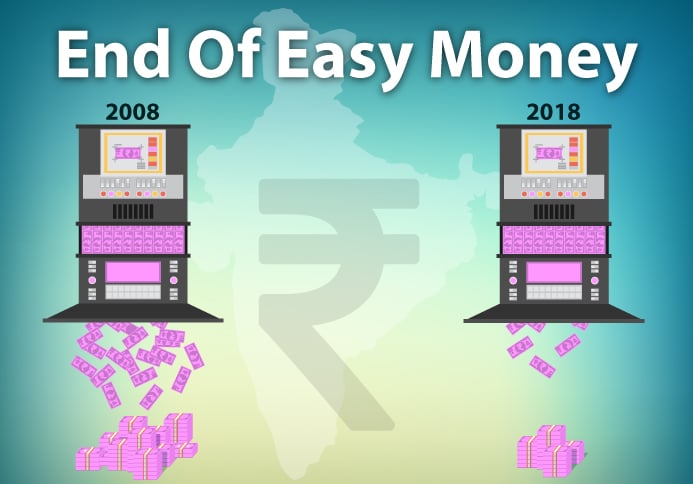
Almost a decade after Quantitative Easing (QE) was adopted by countries to cushion the impact of the 2008 financial crisis and recession, central banks have started unwinding their stance of easy money. Trouble began with the subprime crisis in 2007, and later escalated to a large financial landslide with the collapse of the investment bank Lehman Brothers in September 2008.
Looking back
QE was first used by the Bank of Japan (BOJ) to fight domestic deflation in the early 2000s. QE or easy money is the procedure by which a central bank (like the RBI in India or the Federal Reserve in the US) helps the country’s economy with large-scale purchases of assets. This procedure is embraced to boost investment and aid the country’s economic growth by making money plentiful (and easily available) at low interest rates.
The BOJ had maintained short-term interest rates close to zero since 1999. Since the global financial crisis of 2007–08, policies similar to those undertaken by Japan have been used by the United States, United Kingdom, and the Eurozone. QE was used by these countries because their risk-free short-term nominal interest rates (termed the federal fund rates in the US, or the official bank rate in the UK) were either at or close to zero.
Post withdrawal
The US underwent three rounds of QE – in Nov-08, Nov-10 and Sep-12. On 19th June 2013, then Federal Reserve Chairman Ben Bernanke announced a “tapering” of some of the Fed's QE policies, contingent upon continuous positive economic data.
In October 2017, the Federal Reserve released a policy statement citing following parameters as reasons to end the QE stimulus in the US.
- Low unemployment,
- Rising investment in businesses, and
- Economic expansion.
The central bank of the US has increased its key interest rate 7 times since December 2015.
In June 2018, the European Central Bank (ECB) declared that it would put an end to the easy money regime by December 2018. It cited “strong growth and gradually increasing inflationary pressure” as reasons for the decision. However, ECB decided to maintain a status quo on the benchmark interest rate, and stated that “it expects key ECB interest rates to remain at their present levels at least through the summer of 2019, and in any case, for as long as is necessary.”
The Bank of England is also widely expected to tighten its monetary policy, raising its key rate to 0.75% at its meet on 2nd August 2018. That would be a second hike since November 2017, and policymakers say households should expect rates to rise several times over the next few years.
News reports emerged on 20th July 2018 stating that BOJ plans to discuss a more flexible approach to guiding long-term interest rates when policymakers hold a two-day meeting starting 31st July 2018. Specific actions, including a rate hike, could thus come up for debate before the end of the month.
Emerging markets such as Turkey, Argentina and other countries have also tightened their monetary policies.
Where does India stand?
On the whole, economies of emerging countries (including India) are in the line of fire with the end of the easy money regime. This is because a rate hike or hikes (following the withdrawal of QE) could lead to large outflows of capital from emerging economies to overseas markets like the US, as the difference in interest rates between these narrows.
According to a RBI report, “Tightening of liquidity conditions in developed markets has started to adversely impact emerging market currencies, bonds and capital flows.” RBI’s Governor Urjit Patel wrote a column in a financial daily, requesting the Federal Reserve to ‘ease off on QT (Quantitative Tightening)’.
Deepak Jasani, Head Retail Research at HDFC securities Ltd agrees with this view.
“Rate hikes will also pressurize the central banks of emerging countries to increase interest rates, which in turn will impact businesses – be it the setting up of new projects or expansion plans. This could also lead to increased unemployment. Additionally, the threat of a widening trade deficit cannot be ignored, as a weak Rupee will make imports costlier. Fund availability could also reduce, affecting the working capital cycles of a lot of businesses,” he said.
In a summary
On one hand, the end of easy money reflects the strengthening of economies that had resorted to QE to tide over the Great Recession. On the other hand, it does not bode well for emerging economies, including India.
In a speech, Mr. Bernanke noted this fact. He said,
“Among the advanced economies, the mutual benefits of monetary easing are clear. The case of emerging market economies is more complicated, because many emerging market economies have financial sectors that are small or less developed by global standards, but open to foreign investors. They may perceive themselves to be vulnerable to asset bubbles and financial imbalances caused by heavy and volatile capital inflows, including those arising from low interest rates in the advanced economies.”
The unwinding of QE across the globe can thus be viewed as either a headwind, or alternately a tailwind – depending on which country it impacts, and when.
Related Posts
Don't miss another Article
Subscribe to our blog for free and get regular updates right into your inbox.
Categories




Subscribe for our
newsletter
newsletter
