 HSL Mobile App
 Enhancing Trading Efficiency with Order Slicing
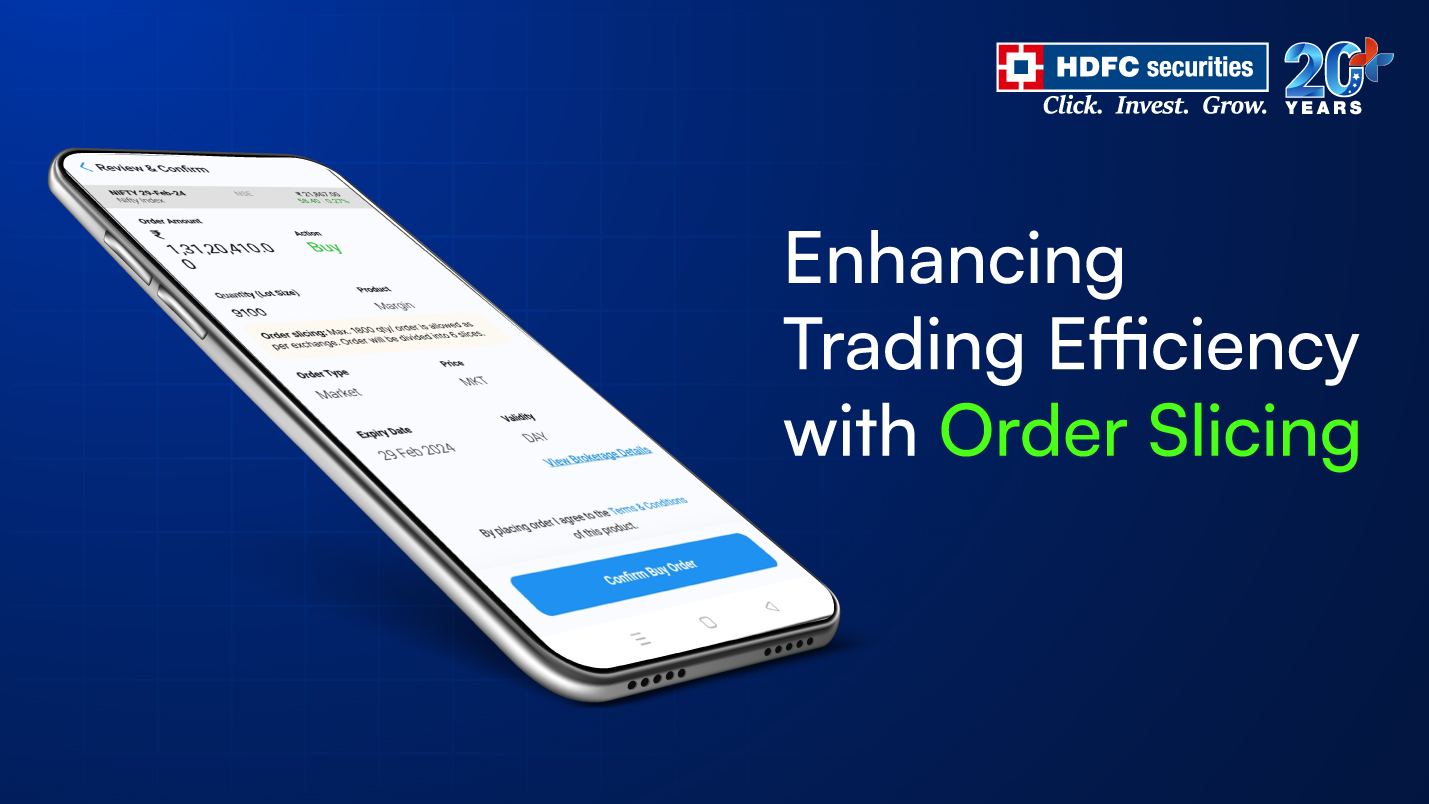
Order slicing is revolutionizing trading by breaking down large orders into smaller, manageable chunks, or ""legs,"" for the derivatives segment on NSE and BSE. This keeps large orders discreet, preventing market moves against you.
Open Demat account with HDFC Sky by HDFC Securities to trade easily with low brokerage and smart features like order slicing.

How It Works
When you place a large order more than the exchange prescribed limit, the system divides it into smaller legs, placed sequentially until the desired quantity is executed. This automation eliminates the need for multiple manual orders, simplifying the process.
Navigating Exchange Limits
Exchanges limit the maximum quantity for equity derivative contracts—72 lots (1800 units) for Nifty and 60 lots (900 units) for Bank Nifty. This can be cumbersome for traders executing larger quantities. Order slicing automates and streamlines this process, handling the multiple orders seamlessly.
Order Visibility and Brokerage
Sliced orders appear in your order book, and traded orders reflect in your net position. Each leg is a separate order, incurring individual brokerage fees. If your order splits into three legs, brokerage applies to all three.

Handling Placement Issues
The system notifies you if any leg fails to place, while the remaining orders follow the planned sequence, ensuring minimal disruption to your strategy.
Fund Management
For Power of Attorney (POA) Y users, funds are automatically blocked. POA N users need to transfer funds before order placement. This ensures a smooth trading experience.
Order slicing enhances trading efficiency, maintaining market discretion and complying with exchange limits, making trading more accessible and effective.
Related Posts
Don't miss another Article
Subscribe to our blog for free and get regular updates right into your inbox.
Categories




Subscribe for our
newsletter
newsletter
