 HSL Mobile App
 ETF vs. Mutual Funds: Key Differences and What to Choose and When
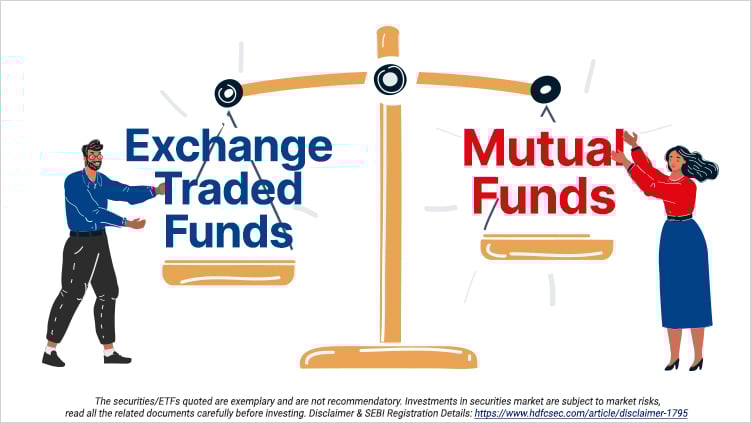
Investors aiming for diversification often consider mutual funds and ETFs (Exchange-Traded Funds). In many aspects, they are similar. Deciding which one to invest in might seem like a trivial consideration, but there are key differences between ETFs and mutual funds that can impact long-term returns.
Understanding these differences will help you choose between the two of them.
Ways They are Traded and Settled
Mutual fund shares are traded once per day after the markets close. They are traded at the NAV (Net Asset Value), which is calculated at the end of the day. In contrast, ETFs are sold and bought at their current market price when markets are open. Share prices fluctuate throughout the day, based on the intraday price changes in the underlying asset.
Intraday trades, limit orders, and short selling are all possible with ETFs, but not with mutual funds. So, if you intend to track the market continuously and look for trading opportunities, ETFs could be a good option. Long-term investors might favour mutual funds, to build a financial corpus based on their risk appetite.To help estimate how your mutual fund investments could grow over time, consider using the SIP Calculator by HDFC SKY for better financial planning.
Management Style
ETFs are passively managed, while mutual funds are managed actively by a professional fund manager with experience, knowledge, and a team of research analysts. Most mutual funds have a minimum expense, while ETFs have none.
Mutual funds, on the other hand, have lower or zero transaction costs compared to ETFs. Transacting ETFs include a transaction cost in the form of a bid-ask spread.
If you don’t have the time or expertise to actively manage your portfolio, consider a mutual fund. Another reason to do that is an actively managed fund’s capacity to outperform the market (not always the case though). However, this makes mutual funds costlier than ETFs to invest in due to higher operating expenses.
Lock-In Period
Some mutual funds, such as ELSS Mutual Funds (Equity Linked Savings Schemes) or tax-saving mutual funds, have a lock-in period of 3 years. ETFs have no such lock-in period.
You can opt for mutual funds that don’t have a lock-in period. Or, you can choose ETFs, where you are free to buy and sell investments as and when you like. This is why ETFs are considered more liquid. If liquid investments are more important to you than long-term investments, choose ETFs, or else invest in a mutual fund to build a corpus for the future.
Tax Implications
Mutual funds typically incur more capital gains taxes than ETFs, due to structural differences. These are passed on to investors through the investment period. ETFs have lower capital gains, payable only on its sale. Mutual funds thus have more tax liabilities than ETFs.
Tax liability might not be a concern in choosing between ETFs and mutual funds. There are many tax-saving mutual funds as well. However, if you want tax efficiency, ETFs could be a choice for you.
Need for Demat Accounts
To transact in ETFs, investors need a Demat account. This account can be opened through a broker. On the other hand, mutual fund investments don’t need a Demat account. However, having one could be useful, as it serves as a commonplace to invest in various asset classes, and also offers a bird-eye view of all investments.
If you are not comfortable opening a Demat account, ETFs are not the option for you. You can buy mutual funds directly from the company at the NAV price during the trading day.
Both the investments–ETF and mutual funds–can help build a diversified portfolio. You need to evaluate various factors like your financial goals, investment time horizon, risk tolerance, and tax savings strategy to choose between the two.
Related Posts
Don't miss another Article
Subscribe to our blog for free and get regular updates right into your inbox.
Categories




Subscribe for our
newsletter
newsletter
