 HSL Mobile App
 Fed rate hikes in 2018: Near certainty
HDFC, Tester
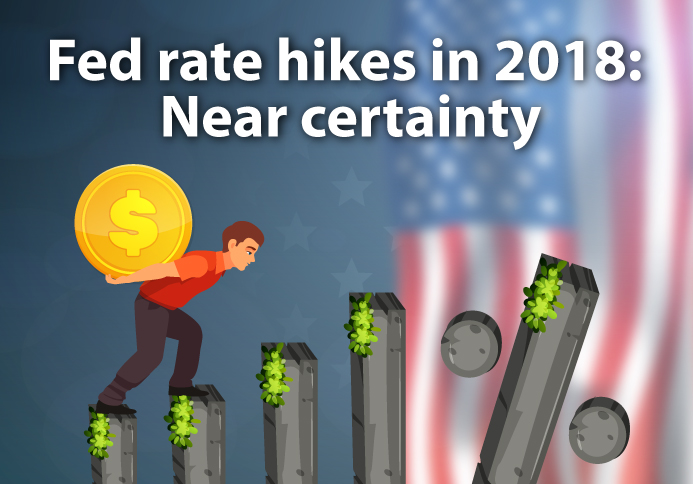
The Federal Reserve (Fed) is expected to gradually increase interest rates this year, which would have manifold repercussions across the globe. After its meeting in March 2018, the Fed increased its federal fund's rate target range by a quarter point, from 1.5% to 1.75%. However, officials at the Federal Open Market Committee concluded the 2nd May 2018 meeting with a unanimous decision to leave the Fed’s benchmark interest rate unchanged.
Going forward, officials in the Fed have said they are planning to raise rates thrice in 2018, which could escalate to four hikes, depending on the unemployment rate statistics released in June 2018.
Repercussions of a rate hike
A hike in rates by the Fed triggers changes across the board. For one, it is likely to cause a ripple effect on borrowing costs. This affects the buying power of consumers, who will have to pay more for their purchases. Businesses also will have to pay more for borrowings or capital required for expansion, or other costs associated with running their businesses, like the funding of payrolls.
The second noteworthy impact of a hike in the Fed rate is a corresponding increase in the prime rate, the credit rate at which banks lend to their creditworthy customers. Various types of consumer credits are based on this, so a higher prime rate results in banks increasing their borrowing costs.
The flip side
A study by Goldman Sachs states that when interest rates rise, it bodes well only for the banking sector. For the remaining businesses across the board, it spells trouble. This is because profitability is impacted by a surge in the cost of capital. This situation could be abysmal for a country that is in an earnings recession.
A hike in interest rates also results in an increase in borrowing costs for the US Government and consequently affects national debt.
Lying low
Minutes from the last meeting (typically released after a period of three weeks) reveal that Fed officials are keen to raise rates again in June 2018. It also indicates that there is relatively lesser worry about inflation rising above 2%, its current level,and the Fed’s target rate. The main cause for worry seems to be that of the rate of inflation dipping again.
The minutes reported that officials said recent economic indicators “had increased their confidence that inflation on a 12-month basis would continue to run near the committee’s longer-run 2% symmetric objective.” But the minutes noted that some officials believed “it was premature to conclude that inflation would remain at levels around 2%, especially after several years in which inflation had persistently run below the committee’s 2% objective.”
The global scenario has also to be taken into account. Economies like Turkey and Argentina could witness a slowing down of capital inflows with the rise in the cost of capital, adversely affecting economic growth.
With chances of the economy overheating, very low unemployment leading to a rapid increase in wages and prices, triggering a sharp rate hike-seen as slim, it seems like this surely is going to be a year of consecutive Fed rate hikes.
Related Posts
Don't miss another Article
Subscribe to our blog for free and get regular updates right into your inbox.
Categories



Subscribe for our
newsletter
newsletter
