 HSL Mobile App
 How ETF Buying and Selling Works
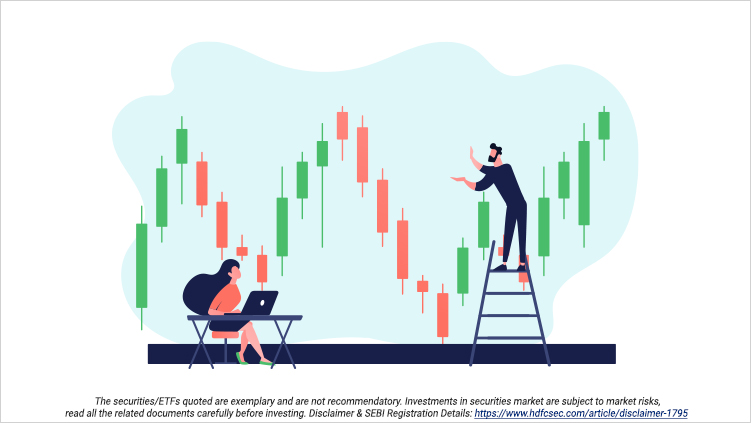
An Exchange Traded Fund (ETF) is a basket of securities, similar to a mutual fund. However, this is where the similarity ends. Unlike a mutual fund, you can purchase and sell an ETF on a stock exchange throughout the day during market hours. This makes it similar to stock trading.
You should take note, that whether it is investment in stocks or mutual funds or any other investment, you must have a Demat account. Hdfc Sky by Hdfc Securities, a platform for investors seeking to Open Demat Account with flat brokerage and low fees, ensuring a seamless and cost-effective trading experience.
How do ETFs Work?
ETFs are managed passively. They aim to replicate the performance of a particular benchmark index. Thus, an ETF invests in the same stocks that are present in the benchmark index, by the same weightage. Passive management is one of the most distinguishing features of ETFs. This means that the fund manager only makes minor modifications to keep the fund replicating the index. This doesn’t mean that a fund manager decides which stocks to buy, sell or hold. It is only the returns that mimic the benchmark index. However, not all ETFs are passive. For instance, Smart Beta ETFs use a hybrid of active and passive investing.
You can easily buy or sell ETFs on a real-time basis, once you have a Demat account. The minimum investment is 1 unit. They have lower expense ratios as well, since they are not managed actively by fund managers. You can take advantage of intraday price movements, which is not possible with open-ended funds. There are many types of ETFs available today, including stock, debt, gold ETFs, and more.
Buying and Selling ETF Units
You can also buy units of ETFs directly from the AMC. However, you cannot buy 1 or 2 units here. You can only create and redeem units according to the defined creation size by the AMC. A creation unit is just the representative basket of all securities from the underlying index in the same weightage. For instance, if the creation unit size of XXX Nifty 50 ETF is 50K units, worth ₹40 lakhs, you need ₹40 lakhs to buy all the stocks in Nifty 50, in the same proportion. You might face impact costs and liquidity issues when buying such large quantities on an exchange.
When you buy or sell an ETF, your decision is based on the predicted performance of multiple companies. The ETF units are created and redeemed as per demand from investors. They may be used for trading, investment or arbitrage. If investors find the value of the underlying index higher than the price of the ETF, they could redeem units with the AMC for higher-priced securities. Conversely, if they find the value of the underlying index to be lower, they may create ETF units by depositing lower-priced securities. This is an arbitrage mechanism.
How Do ETFs Get Their Liquidity
This is an important aspect for buying and selling ETFs in real-time. There are 4 levels of ETF liquidity:
1. Secondary Market Average Daily Volume: This is reflected in the current bid/ask spread and the size that is available for trading.
2. Market Depth: Fund houses appoint market makers to create liquidity for each of their ETFs on exchanges. The ETFs units are created and extinguished directly between market makers and fund houses, so you can buy and sell them easily at any time on the exchange. This means that AUM and trading volumes don’t give complete information. Units are held by market makers that don’t reflect the market depth. So, if you place an order to sell, your order will be executed when the market maker places an order to buy. However, not all ETFs have active market makers.
3. Primary Market: This is the liquidity that comes from the creation and redemption mechanism.
4. Liquidity of Underlying Stocks: How liquid the underlying stocks are also determines ETF liquidity.
The ETF landscape in India is gradually maturing. This means you could have access to more options in the future. Remember to understand the product fully before investing.
Related Posts
Don't miss another Article
Subscribe to our blog for free and get regular updates right into your inbox.
Categories




Subscribe for our
newsletter
newsletter
