 HSL Mobile App
 Insurance industry in India: Readying to take off
The Insurance industry in India stands on the cusp of change. With immense growth potential, this sector is in the process of a complete revamp. Recent years have witnessed an increased thrust on initiatives by the Government as a fillip to spur growth, and steps to increase the sector’s penetration in the country.
Measures Taken
In 2011, the Insurance industry’s regulatory body – Insurance Regulatory and Development Authority of India (IRDAI) – permitted Life Insurance companies that have completed 10 years or more of operations to raise funds via the Initial Public Offering (IPO) route. A number of large-sized IPOs were raised in 2017, namely those of:
- General Insurance Corporation of India,
- ICICI Lombard General Insurance,
- SBI Life Insurance,
- New India Assurance, and
- HDFC Standard Life Insurance.
A notable milestone in this process was the passing of the Insurance Laws (Amendment Bill) 2015 in March 2015. The amendment increased the permissible Foreign Direct Investment (FDI) limit in an Insurance company from 26% to 49%.
Another positive for the industry was when, in 2016, IRDAI permitted insurers to invest up to 10% in additional tier 1 bonds (AT1 bonds). This move will enable Insurance companies to gain from the pick-up in yield, as and when that happens.
Notable Moves
Initiatives undertaken by the current Government have been noteworthy. In March 2018, the Union Cabinet approved the launch of Ayushman Bharat-National Health Protection Mission (AB-NHPM). This scheme aims to provide a cover to 10 crore poor and vulnerable families of up to Rs 5 lakh for secondary and tertiary care.
The Government plans to integrate AB-NHPM with other ongoing centrally-sponsored schemes – Rashtriya Swasthya Bima Yojana (RSBY) and the Senior Citizen Health Insurance Scheme (SCHIS). Each comes with well-planned facets, an example of which can be seen in the RSBY scheme.
RSBY is a Government-run health Insurance scheme for the BPL or ‘Below Poverty Line’ households. It offers cashless insurance and provides for hospitalization in public as well as in certain private hospitals. It became fully operational on 1st April 2008. Though first aimed to help only the BPL households, its purview was later extended to cover other categories of unorganized workers.
Changing with time
In FY-17, RSBY was renamed the Rashtriya Swasthya Suraksha Yojana (RSSY), which was again changed to the National Health Protection Mission (NHPS). While the RSBY offered Rs 30,000 to each deserving family, NHPS aims to provide a Health Insurance cover to 10 crore economically-vulnerable families, with each receiving Rs 5lakh annually for secondary and tertiary healthcare.
This industry received another boost in the FY19 Budget. The continuation of the exemption investments in Unit Linked Insurance Plans (ULIPs) from Long-Term Capital Gains (LTCG) tax was announced while levying 10% LTCG on long-term capital gains from equity mutual funds.
Some Facts
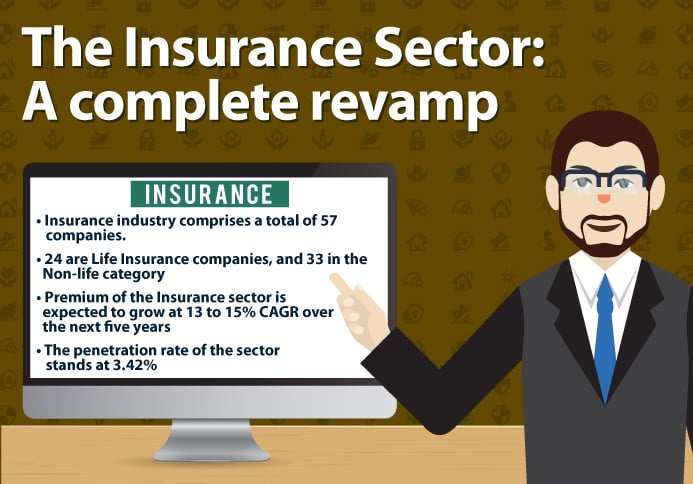
India’s Insurance industry comprises a total of 57 companies. Of these, 24 are Life Insurance companies and 33 are in the Non-life category. Life Insurance Corporation (LIC) is the only public sector company among the Life Insurance companies. There are six public sector companies in the Non-life Insurance segment.
IRDAI is an independent entity formed to regulate the Insurance and reinsurance business in India, and also assist in its growth. A vital function of IRDAI is to protect the rights of policyholders.
Data from CRISIL reveals that growth in the total premium of the Insurance sector is expected to come in at 13% to 15% CAGR over the next five years. It is also likely to rise from Rs 4.18 lakh cr in FY17 to Rs 7.90 to Rs 8.10 lakh crore by FY22. Today, the penetration rate of the sector stands at 3.42%, leaving the enormous potential for growth when compared to the global average of 6.2%.
In a snapshot, it can be said that the much-needed unfolding of the latent potential of the Insurance industry has begun, and should hopefully gather more steam, going ahead.
Related Posts
Don't miss another Article
Subscribe to our blog for free and get regular updates right into your inbox.
Categories




Subscribe for our
newsletter
newsletter
