 HSL Mobile App
 MSP hike: Catch 22 situation
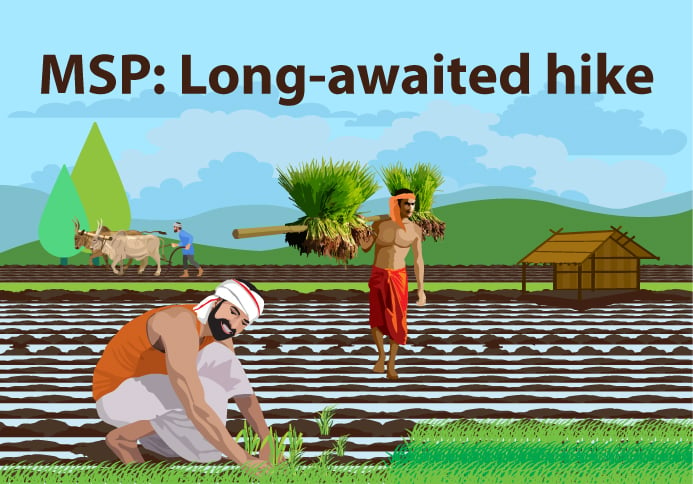
On 3rd July 2018, the Cabinet Committee on Economic Affairs announced an increase in the minimum support price (MSP) for various Kharif crops. The hike is almost one-and-a-half times more than the cost of production of 14 Kharif crops — paddy, jowar, bajra, ragi, maize, tur, moong, urad, groundnut, sunflower seed, soya bean, sesame, niger seed, and cotton.
MSP rising to 50% above the farmers’ cost of production marks the fulfillment of a promise made by the Government to rural India in this year’s Budget. Of the 14 crops, the price of paddy (rice) was increased by 13%, and food grains like maize, jowar, bajra, and ragi witnessed hikes between 19% and 53%. There was also a 28% hike in cotton.
Some Positives
On one hand, this can be viewed as a much-needed breather for rural India. The agrarian community has borne the brunt of factors like pest attacks and erratic or delayed monsoons over a period of time, resulting in widespread damage to the crops. A marked increase in MSP, such as this one, is expected to help farmers by remunerating them adequately for their efforts, which could push them to increase productivity/shift to higher-yielding crops. This, in turn, is expected to result in greater production, increasing the possibility of remedying part of the damage done.
Another side of the coin
Any further damage to crops or farmlands would directly impact India’s Gross Domestic Product (GDP). This is owing to the fact that the agriculture sector contributes 17% to 18% to the country's GDP. In addition to this, it provides employment to 50% of India’s total workforce. The Government’s move covers 19-20 crore tonnes of agricultural output.
However, such a sharp increase in MSP comes with a fair share of challenges. For one, macroeconomic indicators like the country’s fiscal deficit and inflation are expected to be impacted negatively.
Apart from a rise in food prices and increased rural spending, the move is expected to negatively impact the country’s exports. In the previous fiscal (FY18) India exported agricultural produce worth US$38 bn. Of this, 21-22% will be impacted by hikes in MSP, as exports will not be lucrative given higher domestic MSPs. These aspects call for a multi-pronged approach by the Government for the agricultural sector, going beyond a one-off move like an increase in MSP.
Inflation rears its head
Close to 10% of the total CPI (Consumer Price Index) basket could be impacted by MSP hikes. Though inflation will be definitely increased, the result would only be visible in the harvesting season (starting late October 2018).
“In a worst-case scenario, CPI could rise by 35-40bps, and fiscal deficit by 0.1-0.2% of the country’s GDP. This also implies that the possibility of one more rate hike by the RBI in August 2018 remains strong,” says Deepak Jasani, Head Retail Research at HDFC securities Ltd.
Aside from these problems, there are other potential hazards that could plague the agrarian community, going ahead. According to the Economic Survey 2018, climate change is taking a toll on India’s agricultural productivity, along with farmers’ incomes. For the FY19 Kharif season, the average increase in total MSPs stands at 24%. Such a large rise has come after a substantial time lag, as FY13 witnessed an average increase of 29%.
According to Mr. Jasani, “The methodology of calculating the input cost is still debatable. The real benefit to farmers will come when the Government develops and implements a foolproof mechanism to make large-scale purchases of these crops.”
One also wishes that the MSP announcement could have been made before the end of the sowing season, as farmers could have taken an informed decision, resulting in the much-needed diversification of crops.
Related Posts
Don't miss another Article
Subscribe to our blog for free and get regular updates right into your inbox.
Categories




Subscribe for our
newsletter
newsletter
