 HSL Mobile App
 The plunge of the Rupee: No halt in sight?
HDFC, Tester
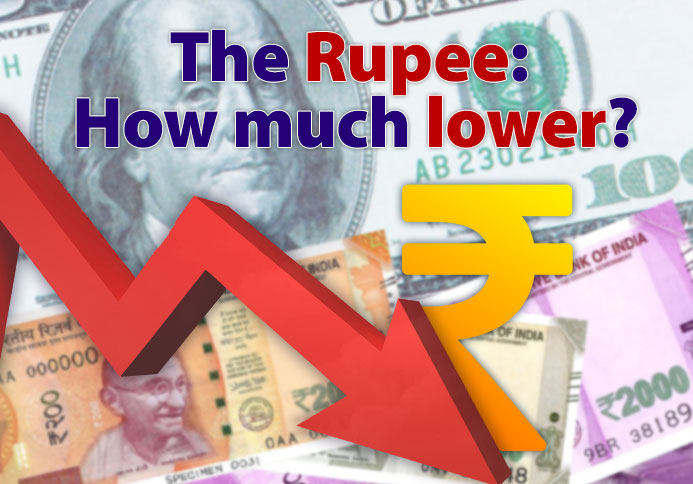
The Rupee’s dive to the 70-mark against the US Dollar is now being viewed as a certainty, rather than a just a possibility. The recent depreciation of the domestic currency to an all-time low of 69.0925 on 28th June 2018 called for immediate intervention by the Reserve Bank of India (RBI). The central bank sold Dollars in both the spot and forward markets, arresting further weakening of the Rupee, and bringing frantic Dollar purchases to a halt for a period of time.
The RBI sold a net US$5.8 billion in the spot and US$6.1 billion in the forward markets in March 2018, the combined sales being the highest ever in any month. RBI continues to defend the domestic currency aggressively, prompting analysts to state that even if the Rupee breaches the much-dreaded 70 level, it would not stay at this point for long.
The flip side
According to the data available with the stock exchanges, FPIs (Foreign Portfolio Investors) have pulled out about Rs 47,800 crore from India’s capital markets in H1 2018. According to a PTI report, this is by far the biggest sell-off in absolute terms since the first half of 2008.
Owing to large capital outflows and RBI constant cushioning the Rupee’s fall, India’s forex reserves have reduced considerably in recent weeks. According to RBI data, between 8th June 2018 and 29th June 2018, India’s forex reserves dipped from US$ 413 bn to US$ 406 bn. Though this may not be a matter of concern now, further diminishing of the forex reserves’ level to support the Rupee is not expected to be viewed favorably.
After a gap of four years, on 6th June 2018, the central bank increased the repo rate by 25 basis points (one basis point is equivalent to one-hundredth of a percentage point). Though this move was not effective in stemming the Rupee’s fall, analysts predict at least one more rate hike by the central bank in the range of 25 to 50 basis points before the end of the year, so its probable impact on the Rupee cannot be ignored.
Other factors
The end of the easy money regime or loose monetary policies by developed economies will also have a bearing on the Rupee. The US Federal Reserve has already raised its benchmark short-term interest rate twice, in March 2018 and June 2018, with two more expected, going ahead. Prompted by higher interest rates, investors would be encouraged to participate in the US markets, which is likely to result in a large outflow of funds from India and other emerging markets.
“Another perilous situation is that of the US-China trade tiff, which is fast bringing other countries under its ambit. If the situation worsens, this could have a negative impact on global trade, and would lead to volatility in the currencies of a host of countries including India, due to its second-order or third-order impact,” said Deepak Jasani, Head Retail Research, HDFC securities Ltd.
Future Snapshot
Weak domestic macroeconomic variables, like India’s widening current account deficit (largely owing to steep crude prices), have also caused the Rupee to weaken.
Year-to-date, the Indian Rupee has lost close to 7%, becoming one of the worst-performing Asian currencies. If the Rupee continues its downward journey, the possibility of the Government announcing some form of NRI deposit scheme/Dollar bond scheme would be a great possibility.
According to Mr. Jasani, “The weakening of the Rupee may halt or reverse only after the formation of a strong and stable Government at the Centre (sometime in H1 CY19). The structural attractiveness of India as a large fast-growing economy will then come back to the fore, resulting in a fast claw back of the Rupee v/s the US Dollar.”
Related Posts
Don't miss another Article
Subscribe to our blog for free and get regular updates right into your inbox.
Categories




Subscribe for our
newsletter
newsletter
