 HSL Mobile App
 US-China trade war: Where does India stand?
HDFC, Tester
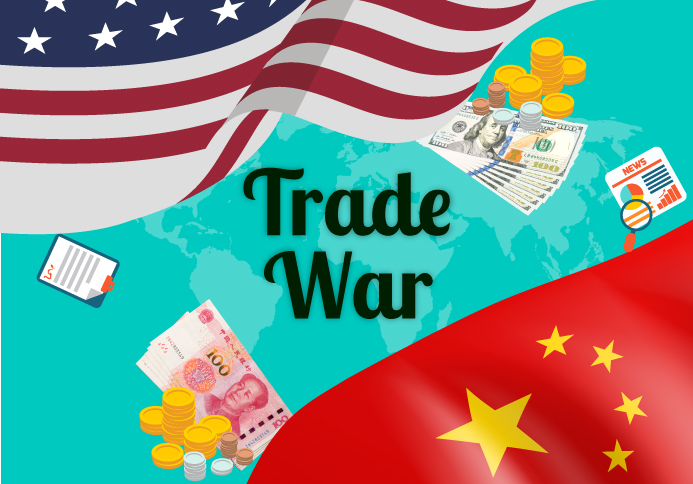
In order to reduce America’s trade account deficit, US President Donald Trump signed two rulings to levy a 25 per cent tariff on steel and a 10 per cent tariff on aluminum imported from all countries except the EU, Mexico, Canada, Argentina, Australia, Brazil and South Korea.
Further, to rectify the highest US$ 375bn trade deficit stemming from trading with China, the US President signed an executive memorandum that aims to impose tariffs on up to US$ 60bn Chinese imports. This would include more than 1,300 products. The US President stated that this is just the start of steps that will be taken to protect the US economy.
This move by the US Government has been countered by China proposing to impose duty on 128 US products worth US$ 3bn. These include:
- Wine,
- Fresh fruit,
- Dried fruit and nuts,
- Steel pipes,
- Modified ethanol, and
- Ginseng.
The US trade deficit is largely in goods, which is moderately offset by a lower trade surplus in services. In 2017, the trade imbalance stood at US$ 568bn, approximately 2.9% of the country’s GDP. This is as a US$ 243bn surplus in services was countered by a US$ 811bn deficit in goods.
A key contributor to this trade deficit is an imbalance in the application of tariffs. Currently, the US imposes lower tariffs on its imports than most of the countries it trades with. As the situation stands today, the impact of the trade conflict between the US and China on India cannot be gauged.
There is a second list of goods imported from China that has been earmarked for the imposition of duty by the US. This is expected to comprise 1,300 products, details of which are not known as of now.
The India factor
However slim, there is a possibility that India could tap the current scenario in its favor. Keeping in mind the prospect of duty being levied on the import of goods from China where India has a stronghold, like garments and textiles, it would markedly widen the scope for exports of these products from India to the US.
A surge in the trade war between the two countries is likely to have an adverse effect on the global economy, with chances of India also being adversely impacted. For one, there are chances of Indian markets being subjected to the dumping of goods. Though the country can counter this by the imposition of additional anti-dumping, the situation will need to be dealt with stronger measures if it worsens. The co-movements between India’s exports and global imports (composed of India’s seven key trading partners) are very strong, with the latter driving the former.
Potential Negatives
Free trade is essential for the health of any economy, however small or large, both in the short and long term. Actions that restrict trade are viewed as dampeners for global expansion, which they hamper by disrupting production, resulting in an increase in costs for businesses, and eventually lowering productivity.
“Overall, while tariff increases the price of imports, it doesn’t always lead to lower imports by itself. Nations/companies import because of the intrinsic advantages in importing an item rather than producing it domestically,” said Deepak Jasani, Head Retail Research, HDFC Securities Ltd.
However, the scope of trade restrictions matter in the degree of disruption caused. Steel and aluminum imports comprise only 0.2% of the GDP of the U.S. The ratio of steel and aluminum from countries exporting to the US is merely 0.1% and 0.3% of their GDP respectively. Thus, the impact of actions taken on tariffs on the global economy is fairly limited, as of now.
For investors, it seems to be a scenario to wait and watch as events unfold. Financial markets have reacted adversely to Donald Trump’s announcement of tariffs on steel and aluminum. Concerns of the trade war are intensifying, leading to the amplification of negative economic indicators, which will definitely impact investor sentiments, going ahead.
“We think bilateral trade and an investment treaty between US and China would give both the countries a level playing field and may emerge as an ideal solution to the current impasse,” said Mr. Jasani.
Exports constitute 12% of India’s GDP, and total merchandise exports from India to the US are less than 2% of the country’s GDP, with aluminum exports at ~ 0.1%. So, on the face of it. Although the impact of a trade war is not expected to be extensive on our country, it will definitely not be completely insulated.
Related Posts
Don't miss another Article
Subscribe to our blog for free and get regular updates right into your inbox.
Categories




Subscribe for our
newsletter
newsletter
